MOWSES Research Showcased at OMAE 2026 in Tokyo
How can we better predict when steel will fracture under demanding conditions? This question was at the heart of a MOWSES contribution presented at the 45th International Conference on Ocean, Offshore and Arctic Engineering (OMAE 2026), held in Tokyo, Japan from 7–12 June 2026. Each year, the OMAE conference convenes a global community of engineers, researchers, technical specialists, and students to share the latest developments in ocean, offshore, and Arctic engineering. As one of the field's premier international events, it fosters the exchange of innovative ideas, cutting-edge research, and technological advances.
Representing the MOWSES project, Amrit Jena, PhD researcher at TU Delft, presented his work under the title "Local Approach DBT Modeling of Steel: Techniques, Trends and Challenges for Accurate Fracture Prediction." His presentation examined the latest approaches to modelling the ductile-to-brittle transition (DBT) in steel using finite element analysis (FEA), highlighting recent advances as well as the scientific challenges that remain in accurately predicting fracture behaviour.
Understanding and predicting fracture is essential for designing safer, more reliable steel structures. Within MOWSES, this research contributes to improving the assessment of welded structural green steels, supporting the development of robust engineering methods that will help unlock the potential of sustainable steel in future infrastructure applications.
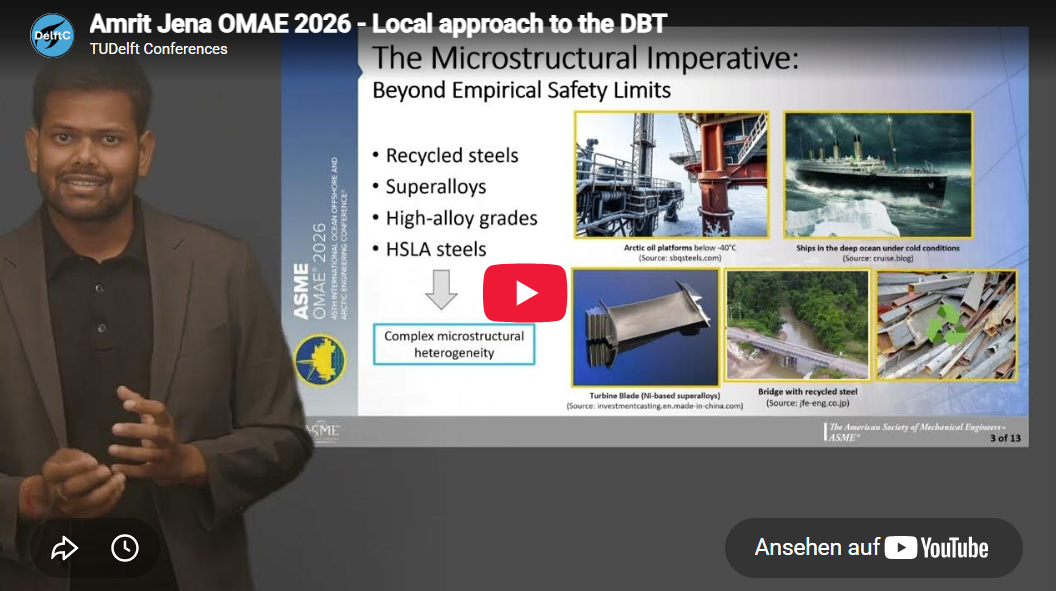
To further share these insights with the wider research community, a recording of the conference presentation is available on the TU Delft Conferences YouTube channel. The video introduces the principles of simulating fracture during the ductile-to-brittle transition using finite element analysis and provides an accessible overview of the research presented at OMAE 2026. Watch the presentation below.
Furthermore, the presentation has been developed into a full publication and is available here.