Introduction: What Fracture Surfaces Reveal About Steel
What happens when steel breaks? And what can the resulting fracture surface tell us about the material's properties, behaviour, and potential causes of failure? Every fracture leaves behind clues. By examining the surfaces created when a material breaks, researchers can uncover valuable information about how and why the failure occurred. This scientific approach, known as fractography, plays an important role in understanding material behaviour and improving the safety and reliability of structures and equipment. Within the MOWSES project, fractography is used to investigate how residual elements influence the fracture behaviour of different steel grades, particularly after welding.
1. Every Fracture Tells a Story: What Is Fractography?
Fractography is the scientific examination and interpretation of fracture surfaces to understand the mechanisms and causes behind material failure. Much like forensic investigators analysing evidence at a crime scene, materials scientists study the patterns and features left behind when a material breaks. These fracture surfaces can reveal whether failure was caused by overload, fatigue, corrosion, embrittlement, or manufacturing defects. They can also provide information about the material's behaviour before fracture, possible material properties that contributed to the failure, and the conditions to which it was exposed. By examining fracture surfaces, researchers can better understand the causes of material failure and identify potential improvements in material selection, manufacturing processes, and structural design. Ultimately, understanding why materials fail is an important step towards preventing future failures and improving the safety and reliability of structures and equipment.
2. How Do Scientists Investigate Fracture Surfaces?
Investigating a fracture surface involves different examination techniques, depending on the size of the sample, the type of failure, and the level of detail needed. The process usually begins with a simple visual inspection, which can already provide general information about the type of failure that occurred. Optical microscopy allows researchers to examine larger surface features, identify evidence of deformation before fracture, trace crack paths, and detect possible defects. Optical microscopy also helps researchers identify areas of interest for further investigation using more advanced techniques.
For a more detailed investigation, Scanning Electron Microscopy (SEM) is one of the most versatile and advanced tools available. Its high magnification enables scientists to examine microscopic fracture features and gain a deeper understanding of how a material fractured. SEM can help researchers locate where a crack originated, understand how it propagated through the material, and investigate how microscopic particles interacted with the crack during its propagation. Additional techniques, including chemical analysis methods, laser scanning microscopy, and 3D profilometry, can provide further valuable information about material and component failure. Together, these methods provide insights into the mechanisms behind material failure.
3. What Do the First MOWSES Investigations Reveal?
Within MOWSES, researchers are investigating how residual elements influence the fracture behaviour of different steel grades, particularly following welding. The first observations reveal that the effects of residual elements are not always the same. In some cases, the addition of residual elements appears to negatively affect material properties associated with failure. In other cases, welded samples of MOWSES green steels seem to remain unaffected by the presence of residual elements in their compositions.
These initial observations indicate that the influence of residual elements on fracture behaviour can differ between the steel samples investigated. Further investigations will provide more information on how each of the residual elements studied within MOWSES influences the fracture behaviour of steels after welding.
4. Exploring Steel Fracture Surfaces
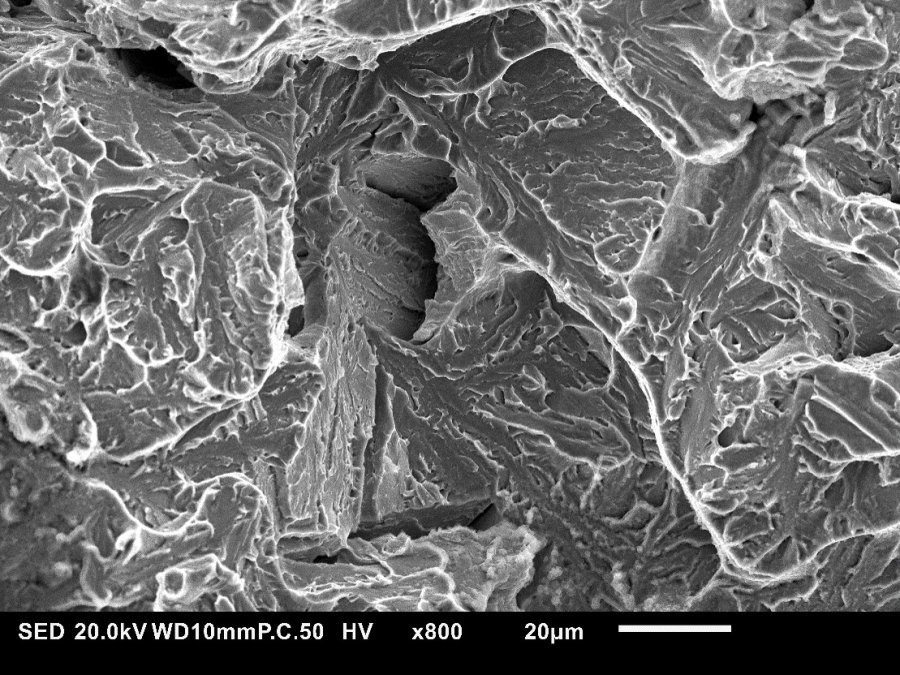
A closer look at fracture surfaces reveals features that help scientists understand how and why materials fail. The following images show fractography in action; a few examples of fractured surfaces of MOWSES green steels as observed during fractographic analysis using an Scanning Electron Microscope.
5. Looking Beyond the Break: Key Findings and Next Steps
So the fracture surface can tell us a lot: from the causes of material failure to the influence of residual elements on steel performance. Initial MOWSES investigations show that these elements can affect fracture behaviour differently, with some negatively influencing material properties while others appear to have little impact on welded steel samples. Further research will help clarify these effects and deepen our understanding of how residual elements influence the fracture behaviour of welded steels. These insights will contribute to the development of safer, more reliable and sustainable steel solutions with increased recycled content.